El 89% de los papers biomédicos muestran huellas de IA: qué dice la cifra
El muro 10 fuentes

Most biomedical publications show signs of LLM-assisted writing
Over the past several years, LLM-powered chatbots and agents have become widely used as a tool for academic writing. LLM-assisted writing can be valuable by removing language barriers but at the same time causes concerns about misconduct and fraud. To inform policy decisions, it is necessary to monitor the prevalence of LLM-altered texts in scholarly publications. Despite some recent progress in this direction, no existing method can produce reliable estimates. Here we suggest and validate a new unbiased approach to estimate LLM usage in a corpus of texts based on changing word frequencies. W…
arxiv.org
Why Does ChatGPT "Delve" So Much? Exploring the Sources of Lexical Overrepresentation in Large Language Models
Scientific English is currently undergoing rapid change, with words like "delve," "intricate," and "underscore" appearing far more frequently than just a few years ago. It is widely assumed that scientists' use of large language models (LLMs) is responsible for such trends. We develop a formal, transferable method to characterize these linguistic changes. Application of our method yields 21 focal words whose increased occurrence in scientific abstracts is likely the result of LLM usage. We then pose "the puzzle of lexical overrepresentation": WHY are such words overused by LLMs? We fail to fi…
arxiv.org
Delving into LLM-assisted writing in biomedical publications through excess vocabulary
Large language models (LLMs) like ChatGPT can generate and revise text with human-level performance. These models come with clear limitations: they can produce inaccurate information, reinforce existing biases, and be easily misused. Yet, many scientists use them for their scholarly writing. But how wide-spread is such LLM usage in the academic literature? To answer this question for the field of biomedical research, we present an unbiased, large-scale approach: we study vocabulary changes in over 15 million biomedical abstracts from 2010--2024 indexed by PubMed, and show how the appearance o…
arxiv.org

Signs of AI-generated text found in 14% of biomedical abstracts last year
Abstracts included telltale words, such as ‘unparalleled’ and ‘invaluable’, that are common in text generated by large language models.
nature.com

The situation has become appalling': fake scientific papers push research credibility to crisis point
Last year, 10,000 sham papers had to be retracted by academic journals, but experts think this is just the tip of the iceberg
theguardian.com
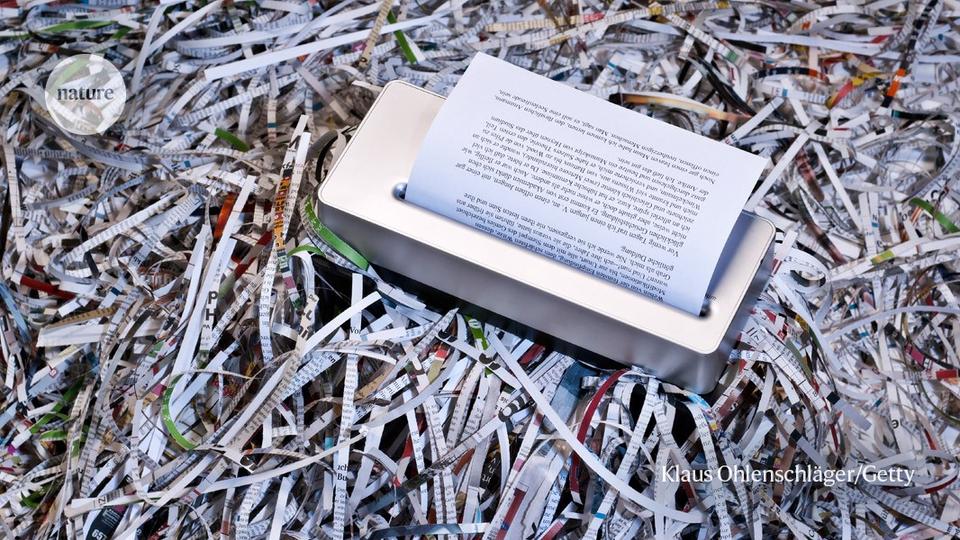
More than 10,000 research papers were retracted in 2023 — a new record
The number of articles being retracted rose sharply this year. Integrity experts say that this is only the tip of the iceberg.
nature.com

Hindawi reveals process for retracting more than 8,000 paper mill articles
Over the past year, amid announcements of thousands of retractions, journal closures and a major index delisting several titles, executives at the troubled publisher Hindawi have at various times m…
retractionwatch.com

Journals infiltrated with 'copycat' papers that can be written by AI
Tools such as ChatGPT can be used to generate almost-identical research papers that pass standard plagiarism checks. Hundreds are thought to have been published.
nature.com
AI tools tackle paper mill fraud overwhelming peer review
chemistryworld.com
Más trends